Posted by Dr Bouarfa Mahi on 05 Feb, 2025

The Whole-in-One Framework (WIOF) introduces a novel perspective on intelligence as an active force that reduces entropy in knowledge systems. Unlike thermodynamic entropy, which naturally increases over time, intelligence functions to decrease uncertainty by accumulating and structuring knowledge. This article explores the fundamental relationship between decision probability, entropy, and the role of intelligence in shaping structured, predictable knowledge. By formalizing this process through the lens of information theory, we gain a clearer understanding of how intelligence transforms disorder into meaningful information.
Entropy, a core concept in information theory, measures the uncertainty or randomness of a system. In traditional physics, entropy tends to increase, leading to greater disorder over time. However, in the cognitive and artificial intelligence domains, the activity of intelligence serves as an opposing force, structuring knowledge and reducing entropy.
The Whole-in-One Framework posits that intelligence does not merely operate within an existing knowledge system but actively refines and restructures it. This process is quantified by shifts in decision probability, which serve as an abstraction of intelligence’s impact on knowledge evolution.
Shannon entropy in a binary decision system is given by:
where:
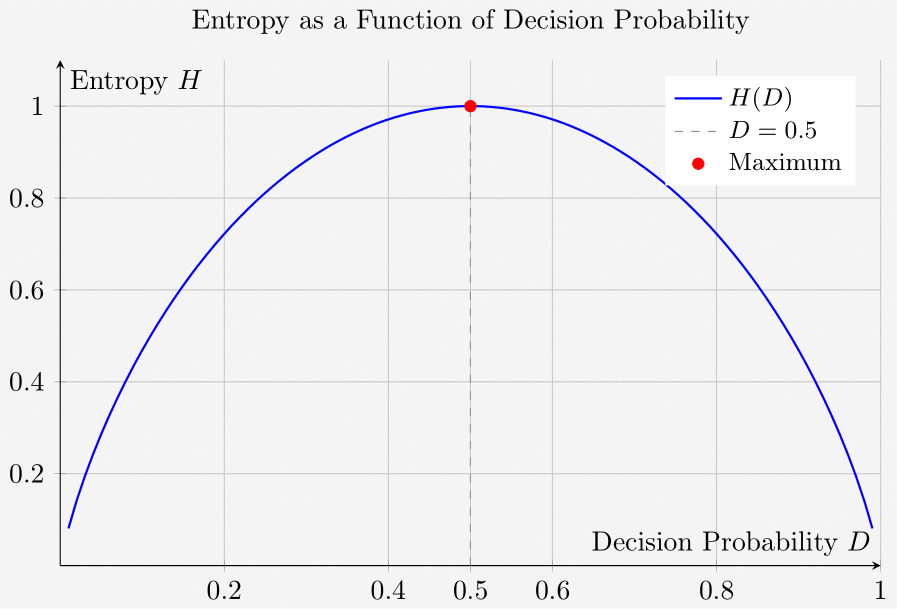
Intelligence operates by increasing decision probability through accumulated knowledge. The Whole-in-One Framework models this process mathematically as:
where:
The Whole-in-One Framework positions intelligence as an intrinsic force that counteracts disorder. This aligns with human learning processes and AI model training:
Understanding entropy reduction allows for:
The Whole-in-One Framework presents intelligence as an active entity that reduces entropy within knowledge systems. By shifting decision probabilities through accumulated knowledge, intelligence transforms randomness into structured understanding. This perspective not only deepens our comprehension of human cognition but also provides new directions for AI development, emphasizing structured learning and uncertainty minimization.
Future research should explore practical implementations of these concepts in AI models, neuroscience, and complex decision-making systems. Ultimately, intelligence is not just about making choices—it is about imposing order on the unknown, driving knowledge evolution through the relentless reduction of entropy.
In a world dominated by uncertainty, intelligence serves as the guiding force that turns chaos into clarity, ensuring that knowledge continues to evolve toward higher forms of abstraction and understanding.
